


Page 8 - nt_twk_en
P. 8
Development in Tsuen Wan New Town


          Population and Housing Mix


          A variety of housing has been developed to suit a range of housing aspirations in the New Town.  High-density
          residential developments are concentrated on sites close to or on top of railway stations while low-density
          residential uses are accommodated at fringe areas and adjoining rural settlements.  Up to 2021, the population
          of the New Town was about 800 400.  Around 336 800 residents lived in public rental housing (PRH), 84 600 in
          subsidised sale flats  and the remainder of about 379 000 in private housing, villages and other temporary and
                             1
          non-domestic housing.

          Upon the planned development, the overall flat mix ratio in the New Town will be about 53:47 between public
          (including PRH and subsidised sale flat) and private permanent housing (including village housing).  The
          planned population for the New Town will be about 917 500.

                                            2
          At present, 36 public rental estates , 19 estates of Home Ownership Scheme, Green Form Subsidised Home
          Ownership Scheme and Private Sector Participation Scheme have been completed in the New Town.  The first
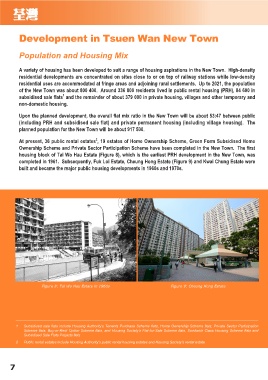
          housing block of Tai Wo Hau Estate (Figure 8), which is the earliest PRH development in the New Town, was
          completed in 1961.  Subsequently, Fuk Loi Estate, Cheung Hong Estate (Figure 9) and Kwai Chung Estate were
          built and became the major public housing developments in 1960s and 1970s.


                   Figure 8: Tai Wo Hau Estate in 1960s                      Figure 9: Cheung Hong Estate


        1   Subsidised sale flats include Housing Authority's Tenants Purchase Scheme flats, Home Ownership Scheme flats, Private Sector Participation
            Scheme flats, Buy-or-Rent Option Scheme flats, and Housing Society's Flat-for-Sale Scheme flats, Sandwich Class Housing Scheme flats and
            Subsidised Sale Flats Projects flats
        2   Public rental estates include Housing Authority’s public rental housing estates and Housing Society’s rental estate


     7

